Chinese researchers and international collaborators make progress in indole skeletal editing
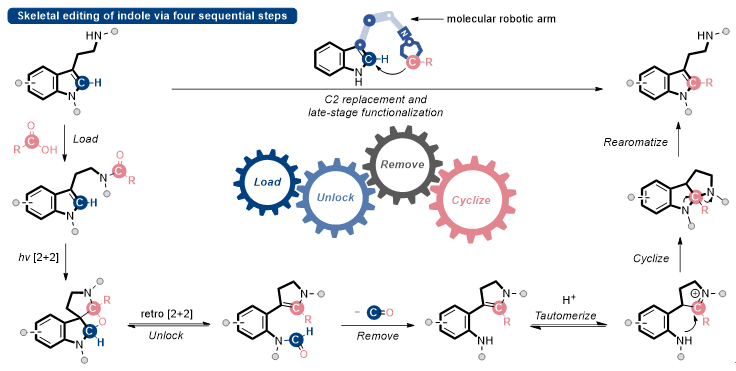
Figure. Indole skeletal editing strategy for single-carbon replacement
Supported by the National Natural Science Foundation of China (Grant No. 22471108), a research team led by Huiying Zeng at Lanzhou University, in collaboration with Chao-Jun Li from McGill University, has made important progress in the field of indole skeletal editing. Their work, titled “Precision indole skeletal editing for single-carbon replacement”, was published online in Science on April 30, 2026. The paper is available at: https://www.science.org/doi/10.1126/science.aec3587.
Indole scaffolds are widely found in pharmaceuticals, natural products, and a broad range of biologically active molecules. More than 70 approved medicines contain indole structures. Therefore, selectively modifying indole skeletons while preserving the overall molecular framework is an urgent scientific problem to be solved in synthetic chemistry and drug discovery.
To address the above issue, the researchers leveraged the intrinsic structural features of the tryptamine side chain as a built-in “molecular mechanical arm” to direct intramolecular skeletal editing. Under ultraviolet irradiation, a cascade intramolecular reaction was triggered to achieve controlled reorganization of the indole skeleton. In this process, one carbon atom within the original indole framework was selectively replaced, while a new functional group was simultaneously introduced at the same position in a single operation.
The reaction exhibited broad compatibility with aryl, alkyl, and acyl substrates possessing diverse electronic and steric properties. The strategy also enables isotope labeling and incorporation of amino acid, peptide, and drug-derived fragments, highlighting its versatility for molecular diversification. Using this skeletal editing approach, the team developed the shortest and most efficient synthetic route reported so far for the monoterpene indole alkaloid Quebrachamine, reducing the synthesis from nine steps to four while increasing the overall yield from 17.8% to 31%. By simultaneously enabling skeletal reorganization and site-selective functionalization, this strategy demonstrates significant potential in late-stage modification of complex molecules, total synthesis of natural products, medicinal chemistry, and isotope-labeling studies.
Contact Us

National Natural Science Foundation of China
Add: 83 Shuangqing Rd., Haidian District, Beijing, China
Postcode: 100085
Tel: 86-10-62327001
Fax: 86-10-62327004
E-mail: bic@nsfc.gov.cn