
New Progress in Quantum Dot Superlattices and High-Definition Display Applications
Supported by the National Natural Science Foundation of China (Grant Nos. T2525035, 52102182, 62174104, T2425026 and 52173190), a collaborative team led by Xuyong Yang (Shanghai University), Yuchen Wu (Jilin University), and Tae-Woo Lee (Seoul National University) has reported a major advance in quantum-dot (QD) superlattice optoelectronics for high-definition displays. The study, titled Pixelated Quantum-Dot Superlattice LEDs, was published online in Nature on April 15, 2026 (https://www.nature.com/articles/s41586-026-10392-z).
Colloidal quantum dots are widely regarded as ideal emitters for next-generation displays owing to their narrow emission linewidths, spectral tunability, and solution processability. However, conventional QD thin films suffer from structural disorder, which introduces energetic inhomogeneity, charge accumulation, and efficiency losses—issues that are further exacerbated during pixel patterning. This creates a long-standing bottleneck: reconciling long-range structural order with device-level patternability.
To address this challenge, the team developed an integrated strategy spanning large-area superlattice assembly, pixelated device fabrication, and display system integration. Central to this approach is a ligand–fluoride co-stabilization method that enables the synthesis of shape-defined, colloidally stable rhombic dodecahedral CsPbBr3 perovskite quantum dots. Using a liquid-bridge confined assembly technique, the researchers constructed superlattice thin films with long-range in-plane order and precise spatial patterning.
These ordered superlattices exhibit reduced energetic disorder, enhanced electronic coupling, and emergent superfluorescent behavior. As a result, charge transport transitions from a disorder-dominated hopping regime to a band-like transport regime, leading to improved carrier injection and radiative recombination efficiency while suppressing non-radiative losses and local charge accumulation under high current densities. Devices therefore maintain high efficiency and operational stability even at high brightness.
The resulting pixelated QLEDs demonstrate outstanding performance, achieving external quantum efficiencies exceeding 30%, brightness > 100,000 cd/m², and pixel densities > 5,000 PPI. Integration with thin-film transistor (TFT) backplanes further enables high–gray-scale active-matrix dynamic displays.
This work establishes pixelated QD superlattices as a new materials platform for high-performance optoelectronics, offering a viable pathway toward ultra-high-resolution, high-brightness displays for emerging applications such as near-eye displays and AR/VR systems.
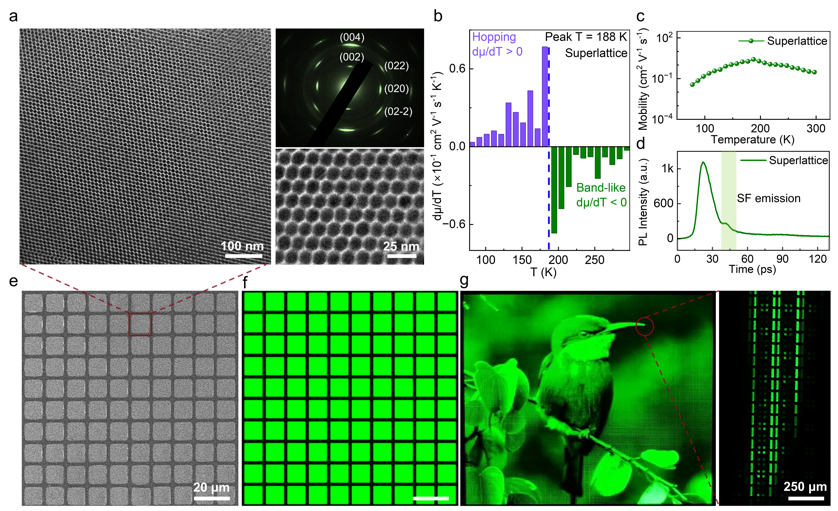
Figure: Pixelated superlattice QLEDs and display integration. (a) TEM, selected-area electron diffraction, and high-resolution TEM images of QD superlattices. (b, c) Temperature-dependent carrier mobility (μ) and dμ/dT curves. (d) Time-resolved photoluminescence decay curves. (e, f) SEM images of QD superlattice arrays and corresponding electroluminescence photographs. (g) Prototype high-resolution display based on QD superlattices.
Contact Us

National Natural Science Foundation of China
Add: 83 Shuangqing Rd., Haidian District, Beijing, China
Postcode: 100085
Tel: 86-10-62327001
Fax: 86-10-62327004
E-mail: bic@nsfc.gov.cn