
Chinese Researchers Propose a New Theory for Classifying Magnetic Order
Supported by the National Natural Science Foundation of China (Grant Nos. 12525410, 12274194, 12574275, and 12534003), Professor Qihang Liu’s team at the the State Key Laboratory of Quantum Functional Materials and Department of Physics, Southern University of Science and Technology (SUSTech) has developed a symmetry-based theory for classifying magnetic order, achieving a breakthrough from traditional phenomenological descriptions of magnetism to a rigorous mathematical framework. The results were published online in Nature on April 22, 2026, under the title “Symmetry classification of magnetic orders using oriented spin space groups” (https://www.nature.com/articles/s41586-026-10401-1).
Magnetism is one of the central subjects in condensed matter physics, with important applications in information storage, spintronics, and quantum materials. Magnetic order is generally classified into two categories, ferromagnetism and antiferromagnetism, depending on whether the system exhibits macroscopic magnetization. However, with the rapid development of antiferromagnetic spintronics and the discovery of unconventional magnetic materials such as altermagnets, the limitations of this traditional framework have become increasingly apparent. The main reason is that, for decades, physicists have relied on magnetic space groups to describe the symmetry of magnetic materials. In this framework, spin rotations are required to remain aligned with lattice rotations, which prevents it from fully capturing the geometric characteristics of magnetic order.
To overcome this problem, the research team adopted the recently developed spin space group framework to classify magnetism. Within this framework, a system is classified as antiferromagnetic if the spin space group ensures complete spin compensation within the unit cell; otherwise, it is classified as ferromagnetic or ferrimagnetic. Building on this idea, the team further introduced the concept of the oriented spin space group as a bridge between the magnetic space group and spin space group frameworks, revealing how symmetry is reduced from the spin space group to the magnetic space group when spin-orbit coupling is introduced. The new framework preserves the full information contained in both types of symmetry descriptions and therefore provides a more complete way to characterize the symmetry of magnetic materials.
Based on this framework, the researchers identified a special type of magnetism within the broader class of antiferromagnetism. In these systems, symmetry breaking induced by spin-orbit coupling generates a net magnetization, and the team named this phenomenon spin-orbit magnetism. Such materials behave as antiferromagnets when spin-orbit coupling is neglected, but develop a finite magnetization once spin-orbit coupling is included, thereby exhibiting macroscopic physical properties similar to those of ferromagnets. Using the noncollinear antiferromagnet Mn3Sn as an example, the team combined theoretical analysis with density functional theory calculations to demonstrate the predictive power of the oriented spin space group framework.
The team also developed an online analysis tool, FINDSPINGROUP (https://findspingroup.com), and used it to systematically screen 2,065 experimentally known magnetic materials from the MAGNDATA database. Among them, 479 were classified as ferromagnetic systems and 1,586 as antiferromagnetic systems. Notably, 224 of the antiferromagnetic materials were identified as exhibiting spin-orbit magnetism, as shown in the figure. This work provides a unified theoretical framework for analyzing and understanding newly emerging magnetic classifications, and it also offers a powerful tool for discovering previously unknown unconventional magnetic materials.
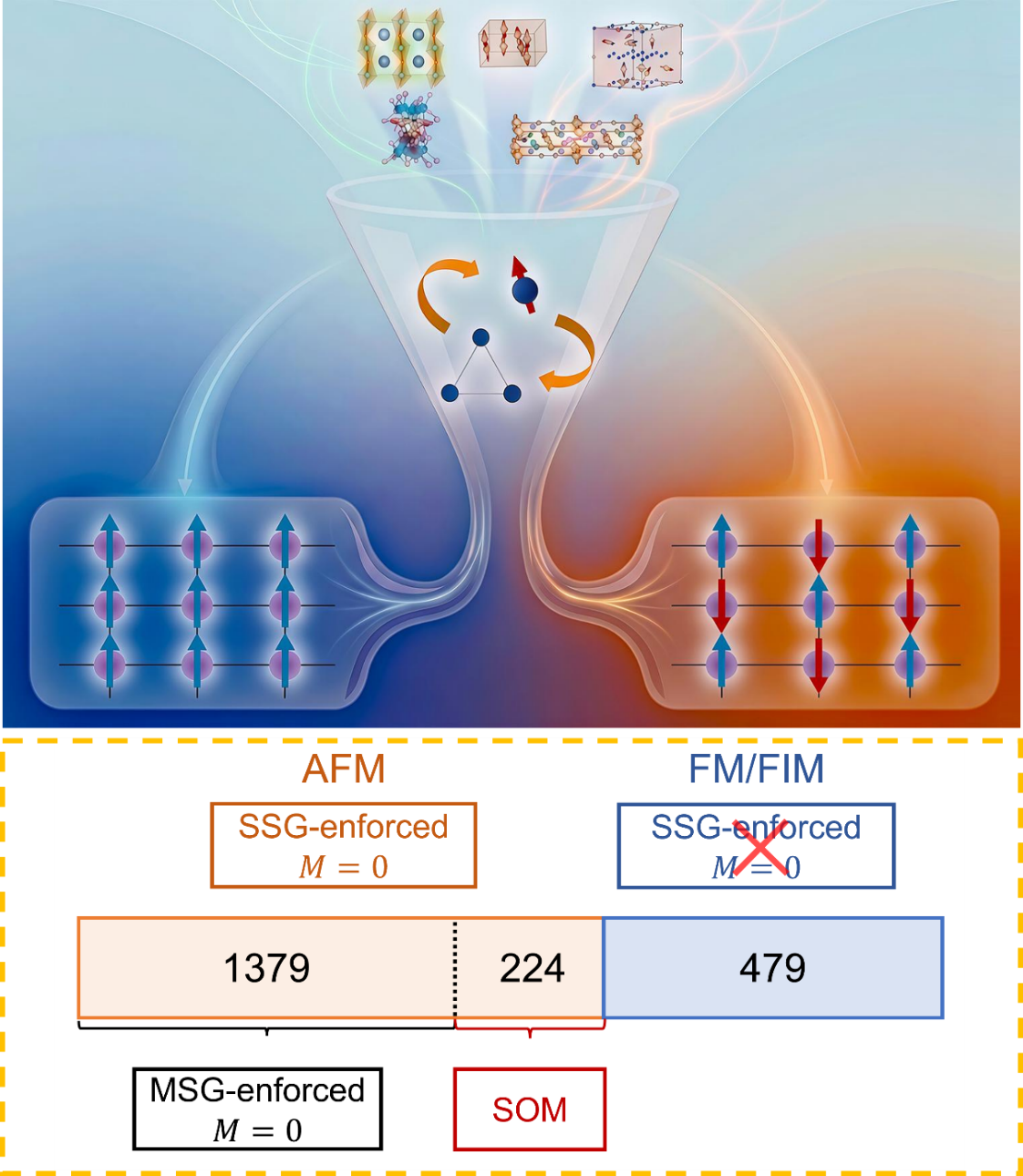
Figure: Magnetic classification based on the symmetry criteria of oriented spin space groups and magnetic space groups, together with statistical results for magnetic materials in the MAGNDATA database.
Contact Us

National Natural Science Foundation of China
Add: 83 Shuangqing Rd., Haidian District, Beijing, China
Postcode: 100085
Tel: 86-10-62327001
Fax: 86-10-62327004
E-mail: bic@nsfc.gov.cn