Chinese Scholars Make Progress in Enhancing CAR T Cell Therapy for Leukemia with Ferritin Aggregation Cell Engager
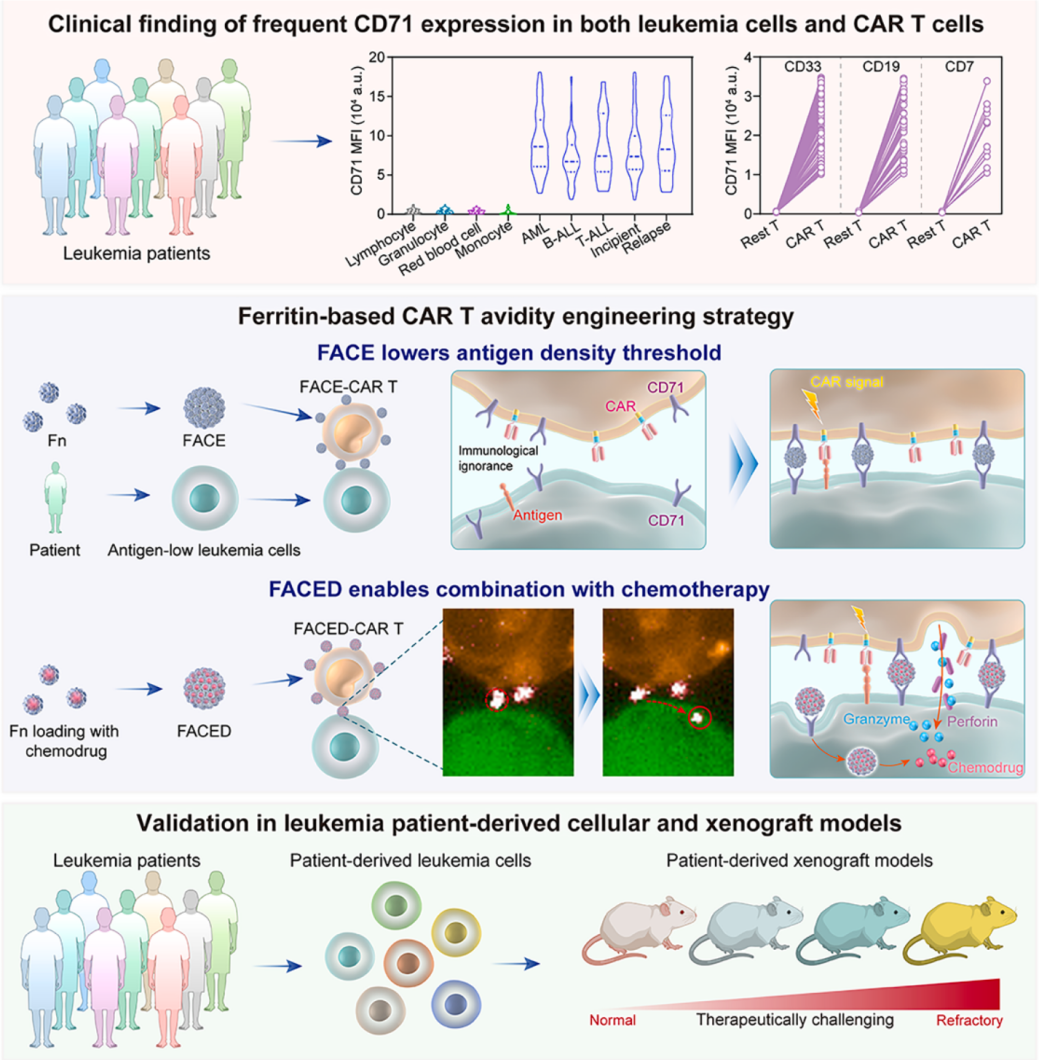
Figure: Schematic diagram of ferritin aggregation cell engager enhancing CAR T cell therapy for leukemia research.
Supported by the National Natural Science Foundation of China (Grant No. T2225021) and other programs, Professor Wei Wei and Professor Guanghui Ma from the Institute of Process Engineering, Chinese Academy of Sciences, conducted interdisciplinary collaboration with Professor Yuhua Li from Zhujiang Hospital of Southern Medical University and Professor Jianxiang Wang from the Institute of Hematology and Blood Diseases Hospital, Chinese Academy of Medical Sciences. Together, they have made significant progress in improving the efficacy of CAR T cell therapy for treating refractory and relapsed leukemia. The research findings, titled "Ferritin aggregation cell engager for CAR T avidity engineering against refractory leukemias," were published in the journal Cell on March 10, 2026. Paper link: https://doi.org/10.1016/j.cell.2026.02.005.
To address the clinical pain point of decreased CAR T efficacy caused by the downregulation of leukemia antigen expression, researchers created a Ferritin Aggregation Cell Engager (FACE) based on a new clinical discovery: both various types of leukemia cells and CAR T cells highly express CD71. This innovation significantly enhanced the interaction between CAR T cells and leukemia cells, elevating the antigen sensitivity of the CAR T cells. At the same time, FACE is capable of precisely delivering chemotherapy drugs directly into leukemia cells, achieving a highly efficient combination of CAR T therapy and chemotherapy.
This strategy has demonstrated significant efficacy in various patient-derived leukemia cells and mouse models, maintaining its therapeutic effect even when antigens are downregulated or absent. Furthermore, based on clinical sample data, the researchers established an artificial intelligence prediction model. By simply detecting the antigen density and CD71 expression levels of a patient's leukemia cells, the model can predict the degree of efficacy enhancement provided by the FACE strategy. This offers an important reference for clinical experts to evaluate which patient populations could potentially benefit from the FACE strategy.
Contact Us
National Natural Science Foundation of China
Add: 83 Shuangqing Rd., Haidian District, Beijing, China
Postcode: 100085
Tel: 86-10-62327001
Fax: 86-10-62327004
E-mail: bic@nsfc.gov.cn