
Chinese scientists develop new nickel-based ambient-pressure high-temperature superconductors through atomic-level precision engineering
Supported by the National Natural Science Foundation of China (Grant Nos. 92565303, 92265112, 12374455, 52388201, 12504079, and 12504165), the team of Qikun Xue and Zhuoyu Chen at Southern University of Science and Technology and the Guangdong–Hong Kong–Macao Greater Bay Area Quantum Science Center, in collaboration with Dawei Shen’s team at the University of Science and Technology of China and others, created two entirely new ambient-pressure high-temperature superconductors under extreme oxidation conditions by artificially designing atomic stacking sequences: a monolayer–bilayer superstructure and a bilayer–trilayer superstructure. Combined with angle-resolved photoemission spectroscopy, they established the electronic band structures corresponding to the superconducting states, providing key experimental evidence for uncovering the mechanism of nickel-based high-temperature superconductivity. The related results, titled “Superconductivity and Electronic Structures of Nickelate Thin Film Superstructures,” were published online in Nature on April 8, 2026. Article link: https://doi.org/10.1038/s41586-026-10352-7.
High-temperature superconductivity is one of the most important research frontiers in condensed matter physics. Following copper-based and iron-based high-temperature superconductors, nickel-based materials are regarded as the third class of systems most promising for revealing the mechanism of high-temperature superconductivity. However, the synthesis of nickel-based superconductors faces a fundamental contradiction: the highly oxidized state required for superconductivity is thermodynamically incompatible with stable lattice growth. The research team’s self-developed “Gigantic-oxidative Atomic-layer-by-layer Epitaxy” technique cleverly overcame this challenge. By creating an ultra-oxidizing atmosphere and an extreme nonequilibrium growth window, the method enables thin films to achieve structural assembly and full oxidation simultaneously during growth. In other words, it allows atoms such as lanthanum, praseodymium, and nickel to be arranged layer by layer exactly according to the design blueprint, while locking in the chemical state of each layer in real time. Using this approach, the team successfully fabricated a series of high-quality superconducting thin films, ranging from pure bilayer structures to more complex superstructures. This technique represents a major technological leap in oxide thin-film epitaxy, providing not only a unique experimental platform for nickel-based superconductivity research but also a new solution to oxygen-deficiency challenges in a wide range of oxide materials.
Building on this technique and starting from the previously discovered pure bilayer (2222) superconducting thin film, the team precisely synthesized three new nickel-based superstructure materials according to artificially designed atomic stacking blueprints: monolayer–bilayer (1212), monolayer–trilayer (1313), and bilayer–trilayer (2323). Among them, 1212 and 2323 exhibit ambient-pressure high-temperature superconductivity, with onset transition temperatures of 50 K and 46 K, respectively, both exceeding the traditional “McMillan limit” of superconductivity theory, whereas 1313 shows only metallic behavior.
The researchers then combined atomic-level precise structural control with angle-resolved photoemission spectroscopy to carry out a systematic comparative study of nickel oxide thin films with four different stacking structures. They found that in the superconducting 1212, 2222, and 2323 structures, a Fermi pocket formed by the γ band exists near the corner of the Brillouin zone, whereas in the non-superconducting 1313 structure, this γ band fails to form a Fermi pocket. This discovery experimentally establishes the crucial connection among atomic stacking configuration, electronic band structure, and superconductivity, identifying the “electronic gene” that determines the occurrence of superconductivity and providing clear experimental evidence for revealing the microscopic mechanism of nickel-based high-temperature superconductivity.
Nickel-based superconductors possess electronic structure characteristics distinct from those of copper-based and iron-based superconductors. A systematic comparative study of these three classes of materials provides a completely new perspective for tackling the century-long scientific challenge of high-temperature superconductivity.
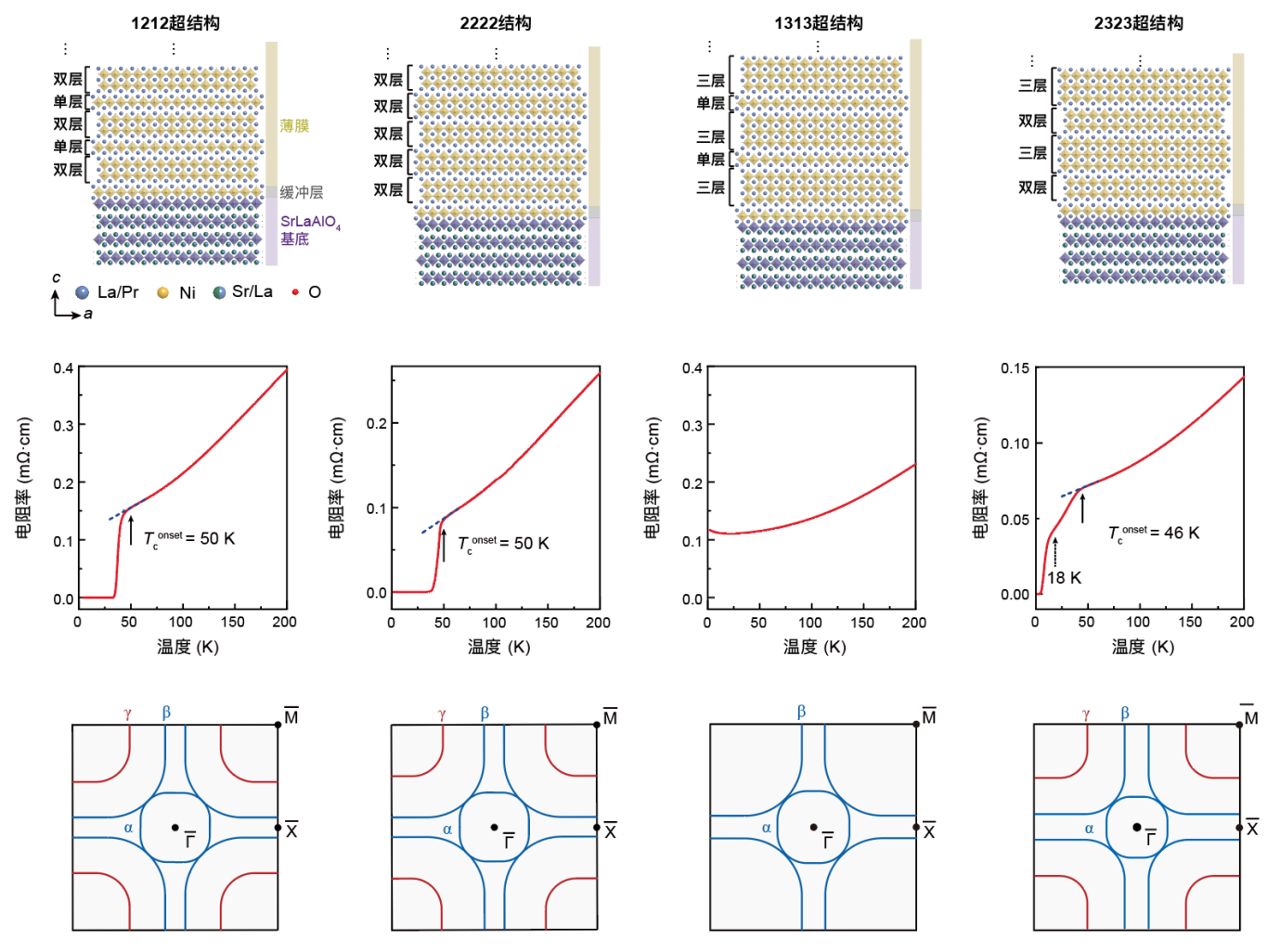
Figure: Crystal structures (top), electrical transport properties (middle), and Fermi surface topology (bottom) of four nickel-based superstructure thin films.
Contact Us

National Natural Science Foundation of China
Add: 83 Shuangqing Rd., Haidian District, Beijing, China
Postcode: 100085
Tel: 86-10-62327001
Fax: 86-10-62327004
E-mail: bic@nsfc.gov.cn