
Chinese Researchers Make Progress in Uncovering How Peripheral Cancer Affects Alzheimer's Disease
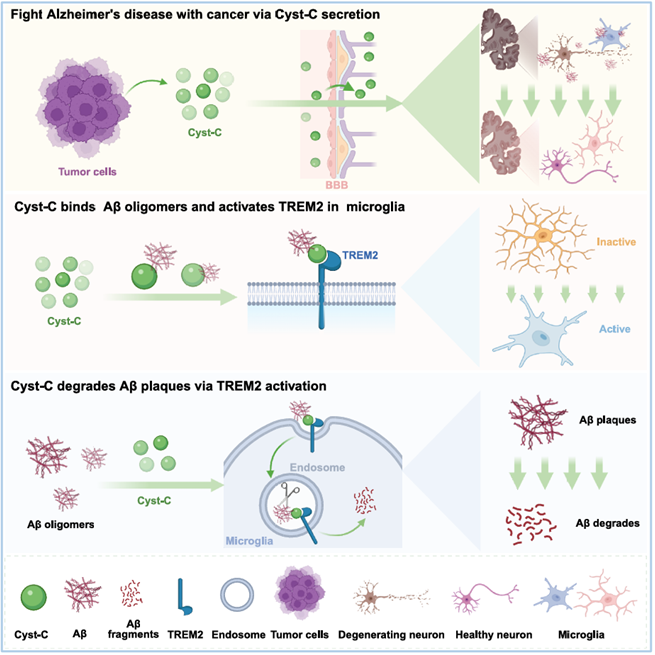
Figure. Peripheral Cancer Inhibits Amyloid Pathology and Rescues Cognition of Alzheimer’s Disease through Secretion of Cystatin-c
Supported by the National Natural Science Foundation of China (Grants 82430044, 32421003, and 82271486), a team led by Professor Lu Youming from School of Basic Medicine, Huazhong University of Science and Technology has made progress in elucidating the mechanism by which peripheral cancer affects Alzheimer’s disease (AD). Their study, titled "Peripheral cancer attenuates amyloid pathology in Alzheimer’s disease via cystatin-c activation of TREM2", was published online in Cell on February 5, 2026 (https://doi.org/10.1016/j.cell.2025.12.020).
AD is a major neurodegenerative disorder characterized by progressive cognitive declines. Amyloid-β (Aβ) protein is the main component of senile plaques, which are commonly described as a pathological feature of AD. Although anti-Aβ monoclonal antibodies can slow down cognitive decline in patients with mild dementia, their long-term efficacy and safety remain controversial. Cancer is also an age-related disease and shares many risk factors with AD. Epidemiological studies have shown a decreased incidence of AD in patients with a history of cancer, suggesting an inverse link between the two conditions. However, whether and how peripheral cancer can affect the pathological progression of AD are yet to be studied.
The team discovered that cystatin-c (Cyst-C), secreted from peripheral tumor cells, penetrated the blood-brain barrier, bound Aβ oligomers and plaques, activated TREM2 in microglia and enabled microglia to degrade pre-existing Aβ plaques. The study showed that peripheral cancer attenuated Aβ pathology and rescued cognition in AD mouse models. The study elucidated the molecular mechanism by which peripheral cancer regulates AD: Cyst-C, as an endogenous agonist of TREM2, can selectively promote the phagocytic function of microglial, thereby establishing a causal link between peripheral cancer and improvement of AD pathology (Figure).
This study reveals a novel role of peripheral cancer-derived factors in regulating neurodegenerative diseases. It establishes a new therapeutic strategy for AD based on enhancing clearance of Aβ plaques in the brain and lays an important theoretical foundation for the development of Aβ-targeted precision therapies.
Contact Us

National Natural Science Foundation of China
Add: 83 Shuangqing Rd., Haidian District, Beijing, China
Postcode: 100085
Tel: 86-10-62327001
Fax: 86-10-62327004
E-mail: bic@nsfc.gov.cn